
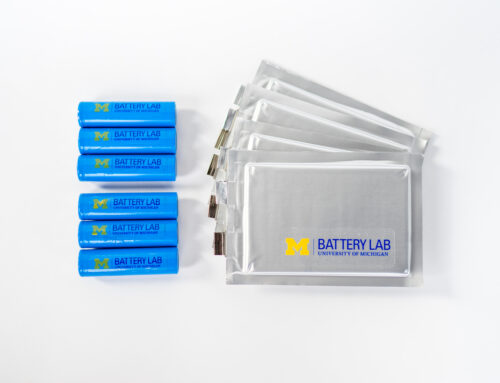
The Battery Lab was established in 2015 as the nation’s first university-based battery cell pilot line. Initial support for the $9 million facility was provided by the University of Michigan, the Michigan Economic Development Corporation, and Ford Motor Company.
Located on North Campus, the original 9,000 sq. ft facility (Battery Lab 1.0) offered coin, pouch, and cylindrical cell prototyping, abuse testing, and a full suite of characterization and cycling capabilities. It quickly became a vital resource for researchers and companies bridging the gap between lab-scale science and pilot-scale manufacturing.
In 2025, U-M expanded with Battery Lab 2.0, an 8,000 sq. ft. facility on Ellsworth Road. This site houses two pilot production lines for pouch and cylindrical cells, a state-of-the-art dry room, automated module and pack welding with the Manz BLS-500 laser system, and expanded access for industry users. The expansion was made possible in part through a historic $130 million investment from the Michigan Department of Labor and Economic Opportunity (LEO) to strengthen Michigan’s EV ecosystem, along with additional support from Ford and the MEDC.
While both Battery Lab 1.0 and Battery Lab 2.0 are currently open and accepting users, we are looking ahead to the future. U-M is developing plans for Battery Lab 3.0 – a proposed 23,500 sq. ft. addition to the UMTRI building. This future facility will consolidate existing facilities and expand capabilities into a comprehensive, centralized hub for teaching, training, research, and collaboration across the EV and energy storage ecosystem.